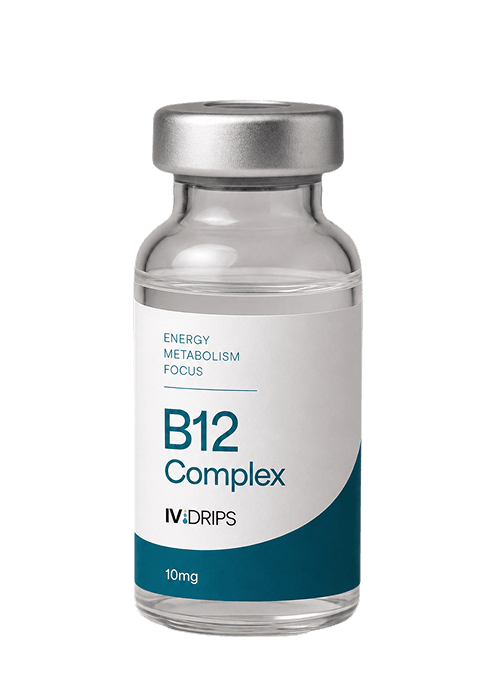
Vitamin B12 Injections in New York City
Vitamin B12 does several things your body cannot do without. It is required for red blood cell formation, for the maintenance of the myelin sheath that insulates nerve fibers, and for DNA synthesis. It also acts as a cofactor in the metabolic pathways that convert food into usable energy.
Real deficiency produces real symptoms. Fatigue, weakness, pins and needles in the hands or feet, difficulty concentrating, mood changes, and a sore or swollen tongue are all recognized presentations. Correcting a genuine deficiency produces genuine improvement, and it is one of the clearer cause-and-effect relationships in nutritional medicine.
Injections are administered by licensed clinicians, either as a standalone treatment or added to an IV infusion for broader support. IV Drips was founded by Bracha Banayan, a board-certified Family Nurse Practitioner with a background in emergency medicine, and the nurse practitioner team reviews your history before dosing rather than treating B12 as a default add-on. That review matters, because whether B12 will do anything for you depends almost entirely on whether you are actually low. Clinical services are provided through NP in Family Health On Demand 24/7 PLLC.
Who Is Actually at Risk of Deficiency
B12 comes almost exclusively from animal foods, and absorbing it requires a functioning stomach and small intestine. Both facts determine who runs low.
- People eating plant-based diets: Vegans and strict vegetarians without supplementation are the clearest case, since dietary intake is close to zero.
- Adults over sixty: Stomach acid production declines with age, and acid is required to release B12 from food proteins.
- Anyone taking metformin: Long-term use interferes with B12 absorption, which is well documented and frequently unmonitored.
- Long-term acid reducer users: Proton pump inhibitors and H2 blockers reduce the acid needed for absorption.
- People with gastrointestinal conditions: Crohn’s disease, celiac disease, and any history of gastric or intestinal surgery affect absorption directly.
- Patients with pernicious anemia: An autoimmune condition that eliminates the intrinsic factor B12 requires to be absorbed, making injections the appropriate route.
If none of those describes you and you eat animal products regularly, your B12 is probably fine. Adding more to an already adequate level will not produce extra energy. B12 is water soluble and the surplus is excreted.
Being Accurate About Injections Versus Tablets
A common claim in this category is that injections are simply superior to oral supplementation. The picture is more specific than that.
For people whose absorption is intact, high-dose oral B12 corrects deficiency about as effectively as injections in most cases. That finding has held up across multiple studies and it is worth knowing before committing to a course of shots.
Injections earn their place where absorption is the problem. Pernicious anemia, significant gastrointestinal disease, and post-surgical anatomy all interfere with the pathway that oral B12 depends on, and bypassing that pathway is the whole point. Injections also help when someone needs levels raised quickly, or when adherence to a daily tablet has proven unrealistic.
So the honest answer is that injections are the right tool for specific situations rather than categorically better. Knowing which situation you are in requires knowing your level.
“Half the people asking me for B12 shots don’t need them, and I’d rather run a test than sell them a course of injections. The other half genuinely do, and for them it makes a real difference.” — Bracha Banayan, FNP-BC, Founder
Why Testing First Is Worth It
A B12 level is inexpensive and settles the question. Blood Work on Demand can run it alongside the other markers that explain fatigue, including ferritin, thyroid function, and vitamin D.
Testing first matters for a clinical reason beyond value for money. B12 supplementation can correct the anemia caused by folate deficiency while leaving the underlying folate problem unaddressed, which allows neurological damage to progress quietly. That is why deficiency is worth confirming rather than assuming.
Neurological symptoms including numbness, tingling, balance problems, or memory changes deserve medical evaluation rather than self-treatment with injections. Those presentations have several possible causes, and B12 is only one of them.
Dosing and Frequency
Dose is tailored rather than fixed, and frequency depends on why you are receiving injections.
Many patients begin with a weekly schedule while levels are being restored, then move to monthly maintenance once they stabilize. Anyone with pernicious anemia or a permanent absorption problem typically requires ongoing injections indefinitely, since the underlying issue does not resolve.
Someone using B12 for general energy support rather than treating a documented deficiency should expect a different conversation, and an honest one about what to expect.
What to Expect
The injection itself takes under a minute. B12 is given intramuscularly, usually into the upper arm or the hip.
Most people feel a brief sting. Mild soreness at the site for a day afterward is common. Bright yellow urine in the hours following is expected and harmless, since it is simply the excess being excreted.
B12 injections are well tolerated. Allergic reactions are rare but possible, and anything involving difficulty breathing, throat tightness, or widespread hives needs emergency care.
Why Choose IV Drips for B12 Injections
- History Reviewed Before Dosing: A conversation about whether you are likely to be deficient rather than an automatic yes.
- Testing Available Alongside: Blood Work on Demand can confirm your level before you commit to a course.
- Honest Comparison With Oral Options: A clear account of when injections genuinely outperform tablets and when they do not.
- Standalone or Added to an Infusion: B12 on its own, or combined with an IV drip for broader support.
- Administered Wherever You Are: Home, office, or hotel across all service areas.
Book a B12 Injection in New York City
If you fit one of the risk groups, or if a test has already shown you are low, a B12 injection is a quick and effective way to correct it. If you are not sure, testing first is the better first step. Book online or call (212) 220-3957 to talk it through. For a comparison of the available routes, see B12 injections, IV drips, or vitamin patches.