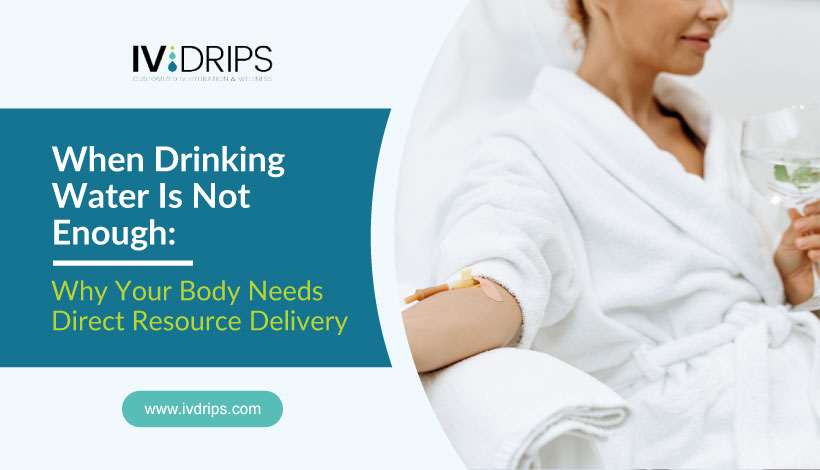
When Drinking Water Is Not Enough: Why Your Body Needs Direct Resource Delivery
By Bracha Banayan, Board Certified Family Nurse Practitioner and Founder of IVDrips
We are often told that the foundation of health is simple: eat your greens and drink eight glasses of water. That is excellent advice for a perfectly healthy person in their twenties. It rarely accounts for the biological reality of what I call the Absorption Tax.
As we age, or when we’re under the strain of chronic illness, the digestive system becomes less efficient, which creates a gap between what you consume and what your body actually uses. Understanding that gap is the first step toward moving from a resource deficit to a steadier baseline, especially for people facing malabsorption in seniors or low oral intake during illness.
The “Absorption Tax”
To understand why direct delivery matters, think of your body as a high-stakes internal project team. Your cells are the front-line staff responsible for maintaining energy, circulation, and immune balance. For that team to succeed, they need a consistent supply of resources.
When you are young and healthy, your digestive tract can act like a reliable delivery system. With age, medication changes, inflammation, and illness, that system becomes taxed. The supplies may still be coming in, but they do not always make it to the worksite in the same way.
- Oral Intake: You might only absorb 20–30% of the vitamins you swallow, especially when the gut is inefficient or inflamed.
- IV Delivery: You get 100% bioavailability because resources enter the bloodstream directly. The “staff” arrives at the cellular worksite immediately, without being sidelined by an overworked
digestive tract.
This is the core bioavailability advantage. It is not that oral hydration and food stop mattering, because both are vitally important. The difference is that in high-demand situations, oral intake can become too slow or too limited to close the gap.
Three Scenarios Where Your “Team” Needs More Staff
In clinical care, there are clear scenarios where the body’s demand outpaces what the digestive system can reliably deliver; that’s where IV therapy for chronic illness and high-stress states can play a supportive role.
- The Chronic Illness Battle: Chronic inflammation is like a constant drain on your resources. When the body is managing autoimmune conditions or ongoing illness, demand rises, and reserves can deplete quickly. Antioxidants like glutathione and vitamin C are part of the body’s defense system against oxidative stress. When the internal team is burning through resources faster than they can be replenished through a taxed gut, IV therapy can help refill stores more efficiently and support a steadier baseline.
- The Cancer Support Bridge: For those undergoing chemotherapy, hydration can become a significant logistical hurdle. Nausea and gut irritation can make oral intake difficult, even when the body needs fluids most. When that happens, chemotherapy hydration support can be helpful. Clinician-supervised IV hydration supports comfort and stamina by restoring fluids without adding workload to the digestive system. At IVDrips, our Recovery Drip is designed for situations where nausea is a primary concern. Any IV therapy during chemotherapy should be coordinated with your oncology team to ensure it aligns with your current labs and treatment plan.
- The High-Performance Traveler: Travel is a massive stressor. Between altitude dehydration from cabin air and time-zone disruption, the internal team is exhausted. A targeted infusion supports hydration and electrolyte balance and can help the body clear metabolic byproducts associated with travel strain. Often, frequent flyers use a travel recovery IV to support their body’s ability to bounce back in hours rather than days, especially when dehydration is a main driver of symptoms.
The Bottom Line
Whether it’s the natural process of aging, the stress of travel, or the significant hurdles of chemotherapy and chronic illness, the body can hit a point where it cannot keep up with demand using oral intake alone.
IVDrips provides the extra staff your body needs to finish the project. By prioritizing bioavailability of vitamins and direct hydration through clinician-supervised care, we help close the resource gap and support steadier recovery when the internal team is under pressure.
Posted on behalf of